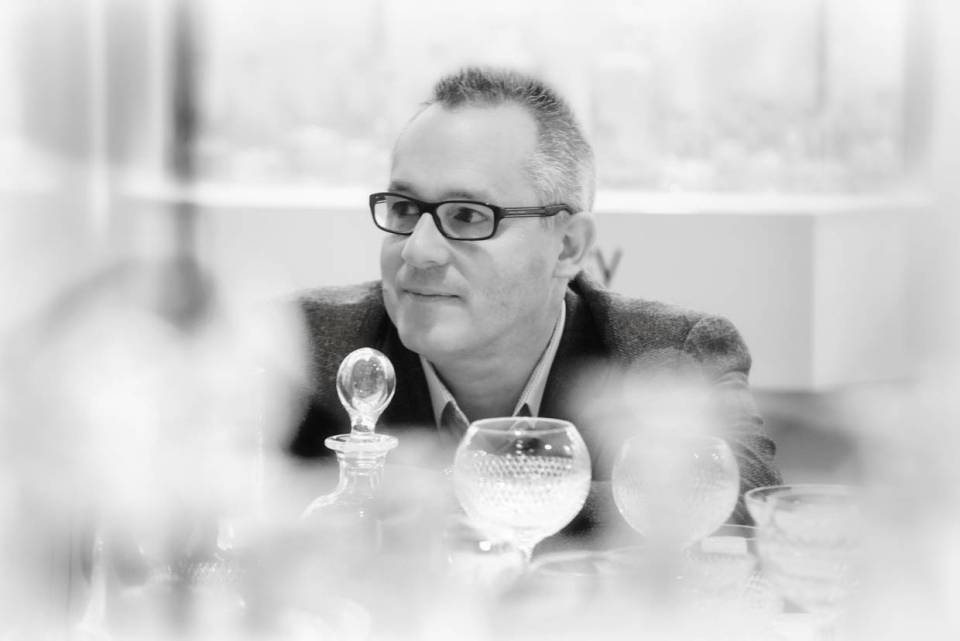
An In Good Company podcast with Chris Blade, CEO Cumbria Crystal
When James Bond couldn't save it, the CEO stepped down to try
It’s been on screen with James Bond. It’s sat on tables in Downton Abbey. And it still wasn’t enough to save the business. At Impact we frame leadership as being about action. And in this podcast we hear the most extreme example of this. Chris Blade - CEO of Cumbria Crystal, the UK’s last manufacturer of luxury English crystal - recently made headlines by stepping down from his own role to save jobs. But that’s only part of the story.
Latest listen
Chris Blade joins Dan to talk about the circumstances that lead a CEO to step down to protect not just a workforce or a small manufacturing organisation – but a craft tradition that stretches back centuries. It may appear to be a drastic decision, but Chris’s passion is clear – he’s not just trying to protect jobs, but protect knowledge that takes decades to build and is dangerously close to disappearing.
If you’re wondering why to listen, thinking this is niche, think again. Rising costs. Fragile talent pipelines. Skills that take decades to build. Suddenly, this doesn’t feel so distant.
"Without the skills of the staff, there is no company"
This isn’t a podcast about crystal making, it’s about what happens when external factors conspire against every positive step you take. And one uncomfortable truth for all leaders: “without the skills of the staff, there is no company.”
Chris's conversation with Dan covers:
- The realities that forced a CEO to step down
- How leaders can protect critical skills in their organisations
- The personal cost of leading when there are no good options
- The surprising link between craftsmanship, creativity, and economic growth
Watch the full episode here:
Why did you step down as CEO?
Well, it was very difficult decision to take. Why would I even be prepared to make a decision like that? Basically it’s because I'm absolutely passionate about the survival of craftsmanship in Britain, particularly glass, which my whole working life has been in. Crystal has been made in Britain since 1686, and so for Cumbria Crystal to be the last of its type, it's personally important to me to try and make sure that our business survives and those skills which take a lifetime to acquire, can be passed on to future generations. So that's the context. The company itself is very small and has done remarkably well over the last 11 years - but everything has conspired to make it very, very difficult for the company. Here’s an example that businesses will recognise. It uses a lot of energy to make glass – but our gas bill is now £40,000 a month compared to £8,000 18 months ago. We do not automate our productivity, we make the very best crystal that can be handmade, using traditional processes and that means we have to rely and invest in the staff. It takes 15 years to train a glassblower, and five years to train a glass cutter. You need a team of them to be able to make a piece of glass - and to my knowledge, there are only eight glass cutters remaining in the United Kingdom. So the skills and the retention of those skills is paramount for us. The company cannot sustain for very long the overheads that we have without laying off staff. And without the skills of the staff, there is no company.
Why do craft skills matter?
These skills matter economically and not just culturally. These skills have been generated, learnt and passed down from generation to generation over hundreds of years. If we lose them, you can probably never regain them. But more importantly, they underpin a lot of other industries, luxury goods, galleries, tourism. Ten years ago, the Crafts Council estimated that craft skills contribute £3.4 billion a year to the general economy, from 10,000 craft practitioners, supporting about 150,000 people in jobs. If you look at creative industries as a whole, government research from last year shows that the creative industries generated £145 billion in Britain. If we lose craft skills we lose a massive part of the support of the financial support for a country.
Can an organisation survive without a CEO?
Many people would say it's ridiculous that the CEO should stand back and cast the ship adrift without without someone at the at the helm. But we don't really have a lot of choice. We cannot sustain our overheads without laying off staff, and my salary was the only one available to the company. A ship with enough momentum will carry on in a direction for quite a long time. You hear about cruise liners that take ten miles to turn around, so it is possible for the company to carry on. Potential future opportunities with companies like Bentley Motors would provide brand awareness and marketing opportunities. Because when people see things like this, or Cumbria Crystal on screen in James Bond or Downton Abbey – it encourages people such as you, me, our friends, family to buy Cumbria Crystal as a special gift for somebody. My hope is that this can make a compelling enough story that we can either get some investment, or we have security that we can slowly start to grow the workforce again, and that will then boost our capacity.
Listen to the episode on Spotify
Find out more about Cumbria Crystal
Support them by buying a special gift or experience
You might also like
Head to Impact's YouTube / Spotify channels to catch up on previous episodes, including…
069: Keeping it real with AI with Aleksandra Brzozowska, Head of Learning and Development at Ringier Axel Springer Polska